
Levelling-up Revisited
The Government's new 'Pride in Place' initiative ticks a lot of the right boxes

In one of my first pieces on here I offered a critique of the then Government’s approach to ’Levelling-up’, their policy to address urban regeneration and address the profound regional inequalities within the UK at the time. In the event, the delivery was haphazard, and the policy label became more of a slogan than a coherent approach to social and economic regeneration. You can read the piece below.

This levelling up policy was essentially a top-down, centrally managed, project-based grant programme. I was concerned, along with many other critics, about whether this approach was likely to be an effective route to sustainable place-based change at local level and whether such local interventions could redress social and economic disparities at area or regional level. Single project financing in the short term did not seem enough for meeting long term goals.
My fundamental argument was that the scheme took no systematic approach to the understanding of place or to the social and economic factors and processes which are necessary to support social change and economic regeneration. The results of the bidding process produced a kind of scattergun approach - some projects relevant and some not so much to revitalizing towns and cities, and some recipient areas not obviously in particularly deprived areas. It did not foster a coherent multi-dimensional approach to area regeneration, and its impact has been limited.
That Government had the benefit of a well-argued White Paper, published in 2022 on ‘Levelling-Up the United Kingdom’. It identified the extent of regional inequalities in pay, in health and wellbeing, in education, in life expectancy and more. The map below taken from the White Paper shows the spatial distribution of inequalities in pay, skills, GVA per worker and life expectancy. and their concentration in particular local authority areas.
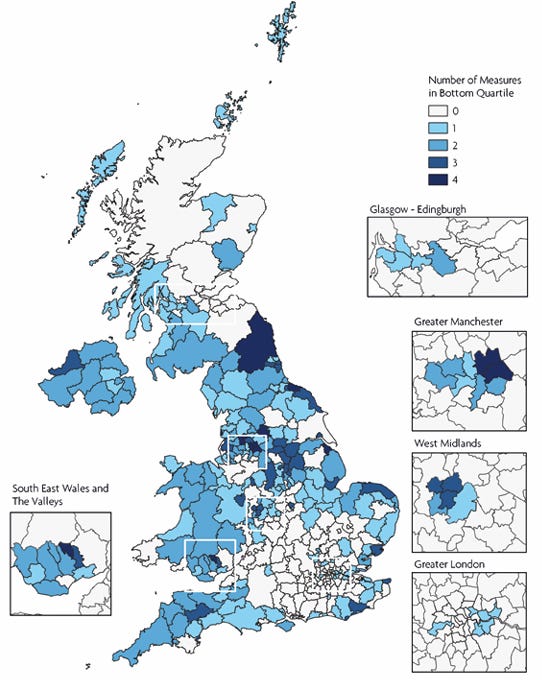
It shows how some areas are multiply deprived, as they fall into the bottom quartile on several aspects of deprivation.
The White Paper also identified 4 policy objectives of a levelling up programme.
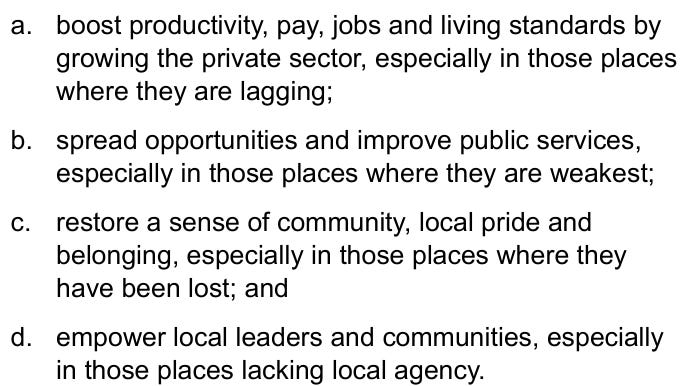
Clearly a comprehensive approach to these objectives requires a whole range of policies, and the levelling up programme was only a small part of the whole. My contention is that the bidding model really failed to address points c and d above. Preparing a bid for a central government grant does not sustain a sense of community or empower local leaders and communities.
Pride of Place Initiative
Last week the current Government announced its new imitative to contribute to levelling-up (although they do not use the term). The £5b initiative will disburse £500m to 339 disadvantaged neighbourhoods over the next 10 years. The recipient areas are identified by the long-established statistical Index of Multiple Deprivation.
The responsibility for spending the allocated funds is placed squarely on the communities and community leaders. It is therefore local, and rests on trusting neighbourhoods to use this extra resource well. It comes with new powers for communities to bring back into use derelict premises , piloting new uses for shops and high street premises, and sustaining youth facilities and the like. There is the belief that local communities can identify and adopt innovative ways to tackle the issues they face, and stop a helpless drift into deprivation.
The faith the programme shows in local communities and the sustained funding should encourage a longer term view of community development, less dependent on winning a series of one-off project grants. It should help grow a sense of community identity.
It is encouraging to see a government coming forward with proposals for a bottom-up approach to place development, and one which has a long-term resource attached. It should prove a smart investment in social capital.
Of course, this programme cannot do the heavy lifting on its own, but it seems to me to be an important step in acknowledging and enabling community agency in addressing its own issues. This action has to be in a context of a range of national and regional programmes to boost economic investment, job creation, access to skills and health and well-being. But allowing neighbourhoods this kind of opportunity to find innovative social entrepreneurship in this way to set the local alongside macro top-down policies is welcome. It gives a big boost to the notion of place-based policymaking.
Levelling up from the bottom up

Since the economic downturn in the UK in 2008, government policy has become strongly focused on the macro-economic conditions for recovery and the role of local and regional bodies in driving economic growth. Recognizing the widespread inequalities between towns and cities around the country ‘levelling up’ has become a mantra of the present government f…