
Celebrating Jane Jacobs
As Jane's Walks festivals are taking place in hundreds of cities worldwide this weekend, why is it her legacy is still so influential in our cities

Jane’s Walk is an annual festival of free, community-led walking conversations inspired by Jane Jacobs. On the first weekend of May every year, Jane’s Walk festivals take place in hundreds of cities around the world. Jane’s Walks encourage people to share stories about their neighbourhoods, discover unseen aspects of their communities, and use walking as a way to connect with their neighbors.
Jane’s Walks was founded in Toronto in 2006 by a group of Jane Jacobs’ friends and colleagues as a way to honor her life and activate her ideas. That first year, there were a handful of walks in Toronto. Over the next decade, the movement saw rapid global uptake by urban activists. In 2017, 1,700 Jane’s Walks took place in 225 cities around the world, spanning 37 countries and 6 continents. The movement continues to grow every year and has now reached over 500 cities.
So what is it about her work and actions which people find so inspiring? It almost as if Jane Jacobs has become a kind of patron saint of urbanism and urban activism. She is widely regarded by planners, architects, and community groups alike as the guru of walkability, mixed‑use neighbourhoods and human‑scale streets. Her 1961 book The Death and Life of Great American Cities is still treated as a founding text of modern urban thinking and ‘new urbanism’.
She is very widely quoted: her key concepts like ‘eyes on the street’ and ‘street ballet’ are almost mythologized. Perhaps it is time to look at the relevance of her legacy in the light of the challenges cities face in the 21st century.
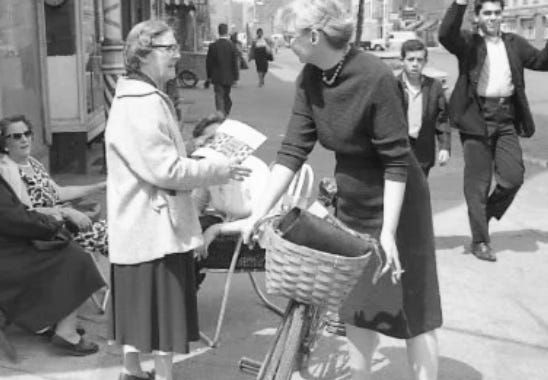
Jane Jacobs (1916–2006) was an American-born writer and activist. best known for her writings about cities. The Death and Life of Great American Cities (1961), upended the ideas of modernist city planning and building, and offered a new vision of diverse, fine-grained cities made for and by ordinary people. After moving from New York City to Toronto in 1968, she published six more major books about cities, economics, ethics, governance and culture, two of them Canadian bestsellers.
The Death and Life of Great American Cities (1961), exposed the failures of the typical approaches to urban renewal of that time and argued instead for dense, mixed-use communities where street life, pedestrian safety, and natural surveillance flourished. Her activism to keep traffic out of public spaces, such as her campaign to close Washington Square Park to cars, cemented her legacy as a grassroots champion of urban vitality and safe streets. Her ideas profoundly influenced modern urban planning and inspired the New Urbanism movement.
Her legacy endures through numerous honors, including the 1996 appointment as an Officer of the Order of Canada and the 2002 American Sociological Association’s Outstanding Lifetime Contribution Award. Toronto established the Jane Jacobs Prize, which annually recognizes individuals contributing to urban life, while her birthplace, New York City, honored her with the Jane Jacobs Medal, celebrating those who make significant contributions to urban design. She died on April 25, 2006, when memorial initiatives like “Jane’s Walks” were created.
Density done well
Jacobs proposed principles that went against conventional wisdom, arguing for “mixed primary uses,” which called for diverse urban activities within a single neighborhood. She urged professional urban planners to understand that a city is more than its economy and its structures, that it is made by the everyday lives and interactions of people. Through her writings and ground-level protest work in both New York and Toronto, she nudged people to not get carried away by the gleaming narratives of urban development current at the time which render people and places invisible. Her vision and ideas focused on sense of place, micro-level interactions, street as a theatre of everyday ballet, the importance of neighbourhoods, and the resistance to top-down large-projects city building undoubtedly still hold relevance today. She advocating for natural surveillance created by engaged, active residents. Her work dismissed zoning laws and advocated for organic growth, challenging planners who preferred order and predictability.
Paradigm shift
She faced considerable criticism but her work continues to be read, around the world, by people interested or curious about cities. Jacobs’ most enduring contribution was her insistence that cities must be understood from the street up, not the drawing board down. She rejected the idea that cities could be rationally engineered through zoning, highways, and superblocks. Instead, she framed cities as complex systems whose order emerges from countless small interactions.
Her approach legitimized forms of knowledge based on observation, ethnography, local memory and tacit expertise that planners had long dismissed. observation, ethnography, local memory, tacit expertise and the importance of the neighbourhood. She offered a new vocabulary for describing urban life: “eyes on the street,” “sidewalk ballet,” “mixed primary uses” which became concepts enabling people to articulate what they valued in their lived experience of the city.
Her approach also seeded later movements such as New Urbanism, tactical urbanism and placemaking which continue to shape practice today.
It should remembered that Jane Jacobs was not just a neighbourhood activist. In her later books ventured into economics, systems theory, and political philosophy. Although they were less grounded in her observational studies, she argued that cities and not nations are the true engines of economic development. She explored how innovation emerges from dense, diverse networks. She advocated what we now call local place-based policy making. She was working towards a theory of creativity which anticipates contemporary thinking about clusters, agglomeration, and innovation ecosystems.
Blind spots
So Jacob’s writing contributes hugely to the development of many concepts and strands of thinking in modern day urbanism, but there are some blind spots thrown up by social, economic and political developments in recent years. Jacobs excelled at reading the micro‑scale of the street and the neighbourhood but her focus on local agency can underplay the wider constraints imposed by wider external factors. In an era defined by housing crises, climate change and widening inequality, cities cannot be understood or governed solely from street level. Her analysis gave less emphasis to the structural forces that shape urban life like racial tensions, labor markets, state power, capital flows and global economic change.
Contemporary relevance
It seems that Jacobs’ relevance today lies less in her specific prescriptions and more in her insistence on complexity, diversity, adaptability, and iterative change which maps onto contemporary emphasis on resilience and systems design.
New 21st century challenges expose the limits of her framework, for example
Spatial justice: Jacobs cared about ordinary people but did not develop a structural analysis of inequality.
Global South urbanization: Her ideas, rooted in mid‑century North America, do not always translate to rapidly growing megacities.
Climate resilience: She used ecological metaphors but did not address environmental limits or climate adaptation directly.
There is much to celebrate in the ideas Jacobs set out, and the developing practices in modern planning and community development owe much in a very direct way to her contribution, and the paradigms pursued so energetically. But to address important challenges in cities today requires extending her ideas into domains she did not explore or indeed anticipate.
Jane Jacobs has endorsed several principles which many will welcome. Her writing values lived experience over technocratic approaches, it emphasizes the value of grounding action in observed realities, it recognizes the role of cities as engines of creativity, and it promotes a politics of local community empowerment.
The task now is not to canonize her but to extend her work. We need to use her insights while recognizing their limits. We need to take her attention to the everyday with a sharper analysis of power, capital, race, and climate. We need to read her not as a blueprint but as a provocation.
A great reminder of her importance and that after all, it's the street-level where the bigger structural and systemic issues show up.
Thanks for this John! There are three Jane's Walks in Edinburgh on Saturday 9 May, all starting at 11am in Leith, Willowbrae and the West End. Full details at https://www.eventbrite.com/cc/janes-walks-2026-4832311.